
2025 / 2026 FFPC Playoff Challenge Overview and Strategy
The FFPC Playoff Challenge is back again for 2025. Whether you are a veteran of the competition, or completely new to it, the information contained in our annually updated overview and strategy article can be a foundational piece of your research for this year’s competition.
1) Overview
You can go to the FFPC Playoff challenge overview HERE for complete rules, but here are the highlights:
Create a roster of 12 Players. There is no draft. Simply select your roster as described below. This will be your roster for the entire duration of the contest. Contest runs from the first week of the NFL playoffs thru the Super Bowl. Each week’s score will be added to your team’s total which will accumulate for the duration of the contest. Super Bowl points will count as DOUBLE the points toward each team’s total.
1-QB
2-RB
2-WR
1-TE
4-Flex (RB, WR or TE)
1-K
1-D
- ONLY ONE PLAYER PER NFL TEAM -> Your lineup will consist of 12 players from the 14 playoff teams. (Which two teams do you fade?) The software will enforce this when you create your lineups
- Scoring is FFPC format (PPR w/ a 1.5 PPR TE premium)
- Final Rosters must be submitted before kickoff of the first playoff game Saturday, January 10, at 4:30pm ET
Similar to 2024, there are two versions of this contest, distinguished by their entry fee. The flagship “FFPC” Playoff Challenge version carries a $200 entry fee per team with a grand prize of $500,000. The $35 version of the contest, with that lower entry fee, has a grand prize of $100,000. Note, however, the number of teams you will be competing against is more than twice as large in the $35 format as the $200 one. The table below compares the two versions of the contest side by side. The contest size and prize structure is nearly identical to what it was in 2024, with the exception of the $200 entry contest now being capped at 7,250 teams, down from 7,500 in 2024, and 7,800 teams in 2023. The past 2 years, there has been some overlay towards contest closing time that may be a reason contest size is shrinking slightly the past two years. The $35 entry contest is exactly the same as 2024.
| FFPC $200 Challenge (High Stakes) | FFPC $35 Challenge (Low Stakes) | |
| Entry Fee | $200 | $35 |
| 1st Place | $500,000 | $100,000 |
| 2nd Place | $100,000 | $50,000 |
| Total Entries | 7,250 | 16,000 |
| Max Entries per person | 150 | 150 |
| Payout Depth | Top 800 | Top 1,800 … Cash Prizes down to 300th place, then $35 team credits thru 1800th place |
| Total Payouts | $1,359,250 | $476,500 |
| Rules and Scoring are the same in both versions | ||
2) Historical Results – Go HERE
This will show player ownership and points scored for 2024 playoffs, as well as links to spreadsheets that SHOW ALL OF LAST YEAR’S 2024 TEAMS IN ORDER OF FINISH .
Strategies:
- Roster players from teams you project to play many games and score the most points. Points from Super Bowl participants are DOUBLED. (Hint: This is important).
- Roster uniqueness is paramount. The top winners historically have unique rosters. Chopping the pot with multiple people can be an anti-climactic finish to an otherwise successful outcome.
- The Perfect 2024 Roster compared with the Winning 2024 Roster reinforces the theme of uniqueness, and it is a trend seen the past 5 years. Winning teams (and perfect ones) will ultimately roster players with lower ownership percentages, but you need a fine balance of chalk top scorers to keep up with the pack in combination with a few sleepers that will separate you from the rest of the pool. Having dissected the winning rosters since this contest’s inception, we have identified roster patterns that essentially become a list of “Best Practices” when building lineups. These need to be combined with your process of actual player selection. To view this analysis and the 2024 Perfect Roster go HERE
- The cash line in these contests stand at the top 11% in the $200 entry version and just the top 1.8% for the $35 version. There are league credits beyond the cash prizes in the $35 version, which put the overall prize line at 11.25%. Take a multi entry, GPP mindset for this contest, and keep in mind that the $200 contest provides a better chance of returning an actual cash prize (versus credits) if that is important to you.
3)How many entries do I need to succeed?
In either format ($35/$200 entry), the maximum number of entries is 150. Let’s look at some facts around entries from the 2024 competition, and let you decide.
$35 Entry
- In the $35 Tourney, 3 teams maxed out with 150 entries (and another had 149). Compare this to 2024 where only 1 team maxed out with 150 entries, we saw an increase in teams who went at this contest hard.
- The overall winner for $100,000 was “djluz” who submitted ONLY 2 entries. Those entries finished 1st overall and 5577th.
- The team that came in second for $50,000 was the team that submitted 149 entries.
- Do you need multiple entries to be a big winner? Obviously the more bullets the better, but as seen, you can also take down the contest with just a couple of entries. This is good news for the more casual gamers.
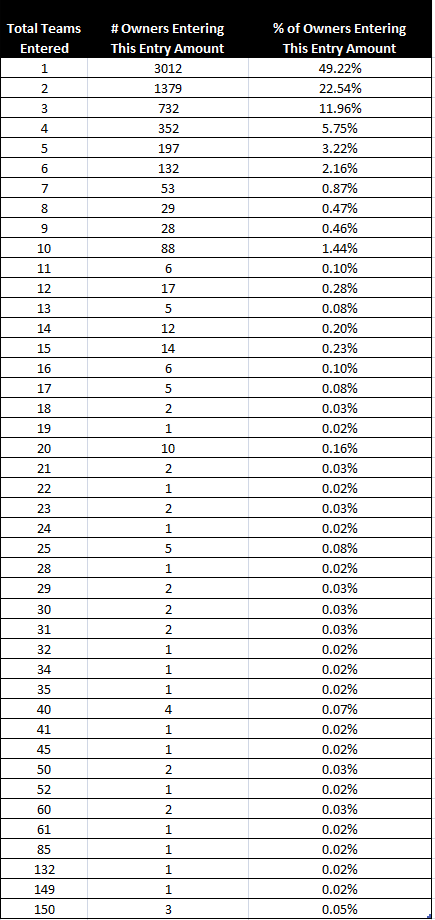
Here is a breakdown showing the number of teams entered by players in 2024. We see that 71% of all players competing in the 2024 $35 challenge entered just 1 or 2 teams, and 84% of the field had 3 or fewer entries. So clearly, the contest is mostly filled with players submitting a meager number of entries.
$200 Entry
- In the 2024 $200 FFPC Tourney, four teams max entered the contest. 150 teams translated to a $30,000 commitment for each owner in entry fees. Of the 600 teams entered by those 4 max entry owners, the highest finishing team was 123. #bruh
- The overall winner of the $500,000 (team “Captain Insano”) entered just four teams, which is another vote of confidence for the low entry owners into the Playoff Challenge (recall the team that won $100,000 in the $35 entry contest had just TWO entries).
- The team that placed 2nd in the $200 tourney (“Badabooks”) and won $100,000, had just THREE total entries.
4) A framework for building your team for 2025 – Go HERE
Many players have their own process, but if you are new to this contest, you may want to consider the process we have outlined. These “Best Practices” are based on institutional knowledge of this contest, built up over years of analyzing the winning rosters that have had success in the tournament.